This page is intended for non-geneticist clinicians seeking information and clinical resources on genome-wide sequencing (GWS). It also includes guidance on obtaining patient consent and resources for pre- and post-test counselling.
For additional frequently asked questions, visit our FAQs.
Pre-testing resources
For the eligibility to genome-wide sequencing in Ontario, see the Patient Eligibility page here.
You can also visit the Provincial Genetics Program website for additional information about indications for which genome-wide sequencing can be ordered by non-genetics providers. These can also be viewed on the PGP Genetics Guidance page.
If you are unsure about your patient’s eligibility for genome-wide sequencing, you may contact the GSO lab of your catchment.
Requisitions to order genome-wide sequencing (GWS) can be found here.
- The requisition to select is dependent on your catchment area
- A requisition is required for each family member sample submitted for testing
- If blood is being drawn at a community laboratory, a Ministry of Health (MOH) blood draw requisition may also be required.
- The ability to achieve a diagnosis for patients can be influenced by different factors, such as the accuracy and completeness of the phenotypic information and family history provided, and the testing strategy (trio, duo, singleton, etc).
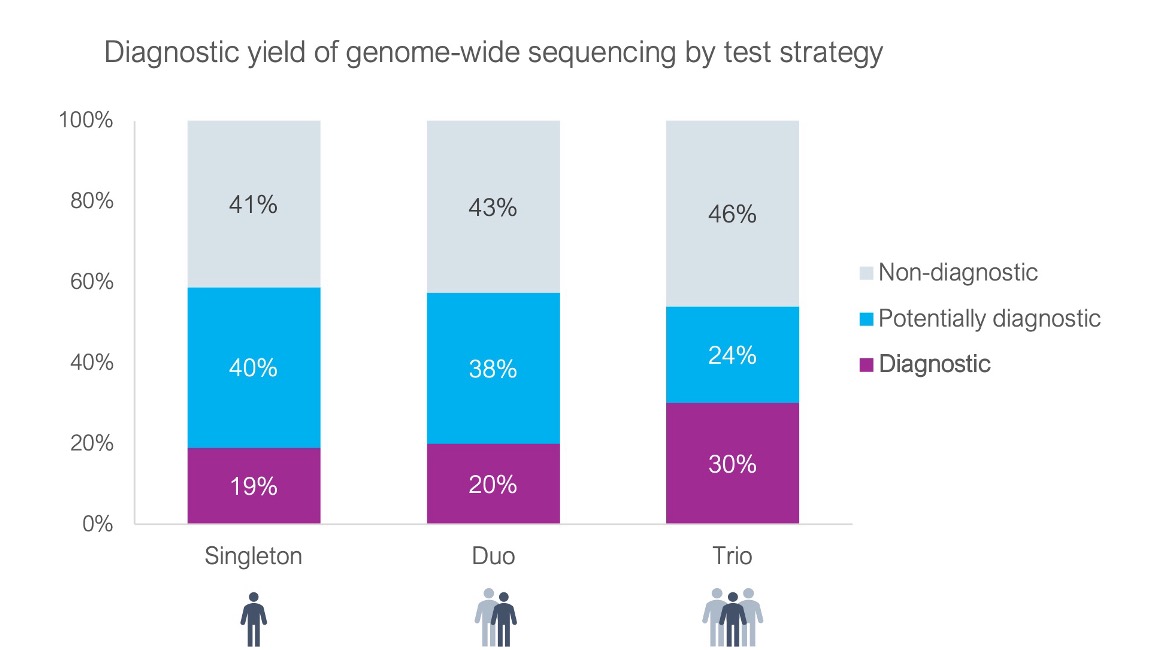
- The ideal test strategy for genome-wide sequencing is a trio (i.e. testing a proband alongside their biological parents).
- The ability to conduct GWS analysis as a trio enhances the lab’s ability to identify variants of interest and clarify if they are likely or less likely to be pathogenic.
- For example, having access to both parental samples allows to lab to determine if a variant is de novo or inherited from a parent that is unaffected or that may share similar features.
- It also allows the lab to determine if the observed inheritance of a variant is compatible with a mode of inheritance.
- Compared to singleton or duo sequencing, the diagnostic yield for trio sequencing is at least 10% higher.
- When possible, it is recommended that trio samples be submitted together for analysis (proband and their biological parent(s) samples).
- Once testing has been initiated, additional family members cannot be subsequently included.
- To order testing as a trio, this requires ordering providers to facilitate sample collection from parents in addition to the patient, as well as obtain consent for participation in testing and the items detailed below.
- Depending on workflows and institutional policies, this may require registration of parents or may simply require providing parents with requisitions for themselves, using their health card information.
- Quad testing, where an affected sibling is also included in the analysis, can be helpful if the sibling is suspected to have the same diagnosis.
- This allows for the analysis to search for variants which are shared between two affected siblings.
- When two siblings have different phenotypes, or are suspected to have two distinct genetic conditions, testing should be submitted as two different cases.
- To inquire about the possibility of submitting a case as a quad, contact the GSO laboratory of our catchment.
- Samples for the proband and family members can be collected at the local hospital or clinic, or at a community lab (e.g. LifeLabs, Dynacare) using the GSO requisitions.
- If the patient has previously had genetic testing at the GSO laboratory and obtaining a new sample is challenging, a new sample may not be required. To confirm availability, please contact the GSO laboratory directly.
- If blood is drawn at a community lab, a Ministry of Health (MOH) blood draw requisition may also be required.
In addition to determining the test strategy, there are three additional decisions that each patient and their family member(s) when consenting for this test:
1) Data Sharing
To help healthcare providers and laboratories deliver better care to patients, laboratories share their interpretation of genetic results. Some level of data can be shared without consent, however sharing of additional information which can be helpful to the interpretation of GWS findings require patient consent:
| For all individuals undergoing GWS | For individuals who provide consent | |
|---|---|---|
| What data is shared? | Gene- and variant-level information, including variant interpretations.
This is confined to the genetic result and the associated genetic diagnosis. e.g. c.4A>G in the SHOC2 gene; classified as pathogenic for Noonan syndrome |
Gene and variant-level information paired with additional details such as GWS test outcome and phenotype.
This can include genetic test results, associated diagnosis, clinical presentation, and demographic details (such as age, sex, and ethnicity). e.g. c.4A>G in the SHOC2 gene; classified as pathogenic for Noonan syndrome; identified in a 3 year old male whose GWS test was deemed diagnostic and who was documented to have global developmental delay and a ventricular septal defect |
| How is it shared? | This data is de-identified: The information that can directly identify the patient has been permanently removed. | This data is coded (rather than de-identified), meaning all personal identifiers are replaced with a code to protect privacy. |
| With who will this data be shared? | Healthcare providers, genetic testing laboratories, public databases | A Clinical Knowledge Network composed of approved diagnostic laboratories collaborating to improve diagnostic accuracy in genomics |
An example of how to discuss this with patients:
To contribute to the knowledge of genetics and help other labs or clinicians, labs can share de-identified genetic data with other institutions, without any additional information about patients. Just like how the lab can use information about whether variants are found in parents to understand results, it is also useful to to know if variants are found in other people that share similar symptoms or that do not have any health or developmental concerns (e.g. healthy parents). Having access to this information can help labs to interpret your test results.
You can decide if you would allow the lab to share such information about you with other diagnostic laboratories. If you agree, this would allow the lab to share information about variants found in you, alongside additional details like symptoms, sex, age, and result of your GWS test. This data is coded, meaning that personal identifiers are removed and does not include identifiers such as name, address, etc. Other labs would not be able to contact you.
2) Secondary and Incidental Findings
When GWS is performed, medically actionable findings in genes that are not related to the primary medical conditions for which the test has been requested may also be reported. These include secondary findings and incidental findings, which can cause other medical conditions during childhood and/or later in life.
- Secondary findings (SF) are pathogenic or likely pathogenic variants in list of genes defined by the American College of American Genetics and Genomics (ACMG). The conditions associated with these genes are considered medically actionable.
- When SF are identified, clear medical recommendations can be made to reduce the risk of the associated condition impacting a person’s health in the future. The list of conditions are defined as actionable in childhood or actionable in adulthood.
- Through genome-wide sequencing analysis, SFs can be actively sought in the proband. The analysis for SF is only performed in the proband. These are identified in up to 5% of cases.
- If a SF is identified in a proband, family members participating in GWS may choose to learn about the inheritance of the secondary finding identified in the proband and have the report indicate if the secondary finding(s) is also present in a parent (if also submitted for testing).
- SFs that are only present in a parent or sibling, but not in the proband, will not be identified.
- Incidental findings (IF): Occasionally, findings expected or known to be disease-causing that are identified in a gene not included in the ACMG gene list may also be reported when considered to be medically actionable. These are called incidental findings.
For more information on the secondary findings reported through GSO, visit the Secondary Findings page.
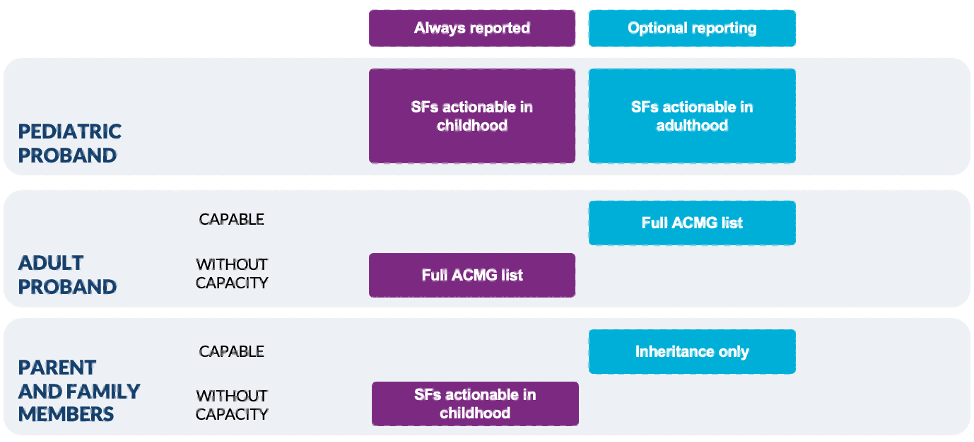
For individuals undergoing GWS in Ontario, the reporting of SF (and IF) depends on the age of the proband (below or above the age of 18 years), their capacity to make medical decisions, and their preference:
An example of how to discuss this with patients:
This test looks at all genes, the main goal will be to find an explanation for your/your child’s condition. However, the lab can also look through a list of genes which are not related to their condition, but which are considered “medically actionable”. Findings in these genes are called secondary findings. For these findings, preventative surveillance or treatment would be available. Examples include conditions that increase the risk for heart disease or cancer. Variants of uncertain significance in these genes are not reported.
For children (≤18 years of age): Any secondary findings that are actionable in childhood will be reported. However, for conditions that are only actionable in adulthood, you can decide whether you would want to know about a secondary finding result that would only impact you/your child in adulthood. An example would be a breast cancer predisposition syndrome that would not be expected to occur or lead to medical recommendations in someone until they are an adult. Would you like to receive these types of results? This analysis will not be done in other family members included in this test, however if a secondary finding is identified in you/your child, they can decide whether they would like to know they also have the same secondary finding.
For adult patients (>18 years of age, with capacity to decide): Having the lab report secondary findings on you is optional. Would you like to receive these results? This analysis will only be done in you, however, in the event where a secondary finding is identified in you, family members included in the test can decide whether they would like to know if they also have the same finding.
This is a personal decision. There is no right or wrong choice.
3) Recontact for future research
GSO can serve as a mechanism to enable identification of eligible participants for research studies:
- Providing consent for recontact is optional and does not imply consent to participation in research.
- Patients (or their substitute decision maker) must decide if they agree to being contacted by the GSO laboratory about approved potential future research studies.
- Research studies could include (but are not limited to) studies that aim to better understand rare diseases, describe the natural history of a condition, or clinical trials.
An example of how to discuss this with patients:
Patients who receive GWS may be eligible to participate in future research studies. Would you be okay if the laboratory reaches out to you in the future about research opportunities?
Consenting to being recontacted does not commit you to participating in a study, but it allows the laboratory where this is performed to let you know about research studies.
If you are contacted, you can decide if you want to be connected to the research team to hear more about the study to decide if you want to join. If the specific study isn’t of interest to you, you could say no at that time.
Post-testing resources
What to do if you need help?
| GSO | gcConnect | eConsult | |
|---|---|---|---|
| Target cases or questions | Guidance specific to genome-wide sequencing, relating to general ordering or a specific case | Guidance that is general or technical, and not specific to a patient | Guidance specific to a case or patient, including questions requiring clinical guidance |
| Service | Both SickKids and CHEO laboratories have dedicated teams of genetic assistants, genetic counsellors, and laboratory scientists available to support providers accessing GWS. | gcConnect is an Ontario Health Initiative that aims to upskill non-genetics providers in ordering genetic testing by providing genetic education and real-time access to genetic counsellors. | eConsult is an online service where health-care providers can request online consultations about specific patients from genetics specialists.
Written guidance/advice is intended to be provided to the requesting provider within ~1 week. |
| Staffed by | Genetic counsellors, genetic assistants, and/or other lab staff. | Genetic counsellors | Medical geneticists |
| When to consult |
|
gcConnect can provide guidance for ordering GWS on issues relating to:
|
Appropriate eConsults include, but are not limited to:
|
| Contact information | The two GSO laboratories are SickKids and CHEO. They both serve distinct catchment areas.
Questions should be directed to lab serving the catchment area of your practice:
|
Website: www.ontariohealth.ca/clinical /genetics/gcconnectEmail: gcConnect@ontariohealth.ca Tel.: 1-844-564-4363 (GENE) or 437-317-1057 |
eConsult website: https://otnhub.ca/ |